
Gain Is an Important Parameter So Important That There Are Two That You Need to Know
Among practitioners who tune PID control loops manually most note their focus on calculating the Gain. What is sometimes overlooked is that there are two different Gain values – one for the process and the other for the controller. Simply put: Process Gain is a model parameter whereas Controller Gain is a tuning parameter. The former describes important aspects of a given process’ dynamic behavior. The later contributes to the PID controller’s responsiveness to disturbances. While Process Gain can be determined using step test data, assigning a value for Controller Gain requires both specific knowledge of the PID controller and the unique objective for the control loop.
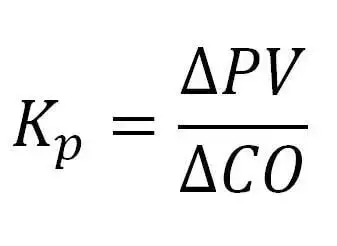
Process Gain (KP) is the sensitivity variable. It determines the relative distance that the Process Variable (PV) travels in response to a change in the Controller Output (CO). Process Gain can be determined by means of manual, graphical analysis using step test data. With data that both starts and ends at a steady state, divide the change in the PV by the corresponding change in CO. Note that the sign – whether plus or minus – is a critical detail as it reflects the direction and denotes the type of controller (i.e. direct acting vs. reverse acting).
 When tuning manually it’s important to be mindful of other attributes of the Process Gain, including:
- Nonlinearity
Processes are generally nonlinear – they behave differently as their operating level changes. When tuning a controller and calculating the Process Gain it’s important that the test data used in the analysis is broad enough to encompass the full range of operation. That range is often referred to as the process’ Design Level of Operation (DLO).
- Percent Span
The calculation mentioned above usually results in a value based on Engineering Units, but most industrial controllers work in units of Percent Span. A calculation must be performed to take into account whatever limits do exist.
- Sized Right
When the value is converted into units of Percent Span, most processes should have a Process Gain ranging from 0.5 to 2.5. Smaller values are often due to a PV range that is too large. Conversely, values larger than 2.5 point to a Final Control Element (FCE) that is oversized, which means the PV is highly sensitive to changes in the CO. There are a variety of aspects that influence the calculation of Process Gain – several of which are noted above. Whether it’s the requirement for a steady-state at both the start and end of a bump test or the need to adjust to Percent Span, there are clear benefits to the use of software which can accommodate each of these automatically. Even so, methods for manual tuning have been used successfully for quite some time and probably will be used for many more years to come.