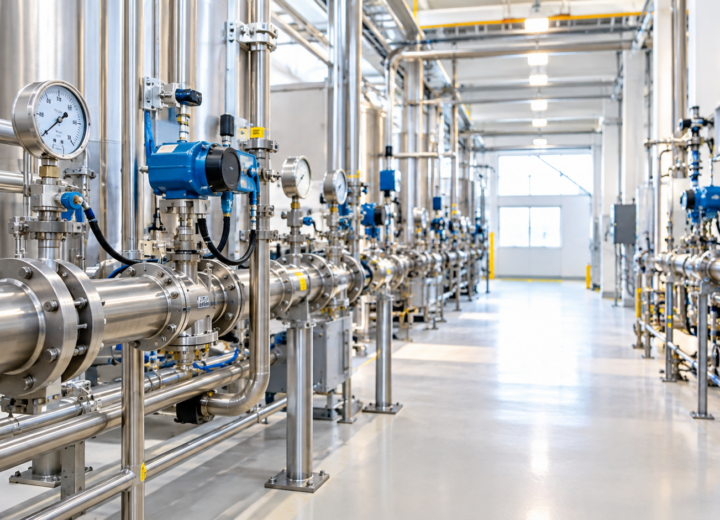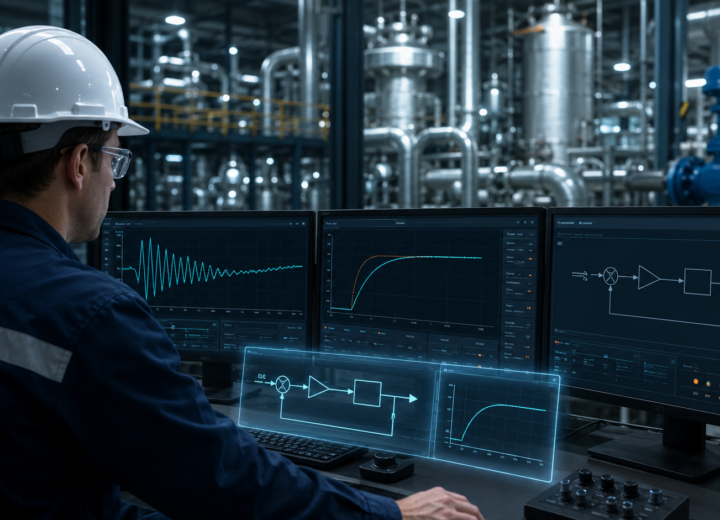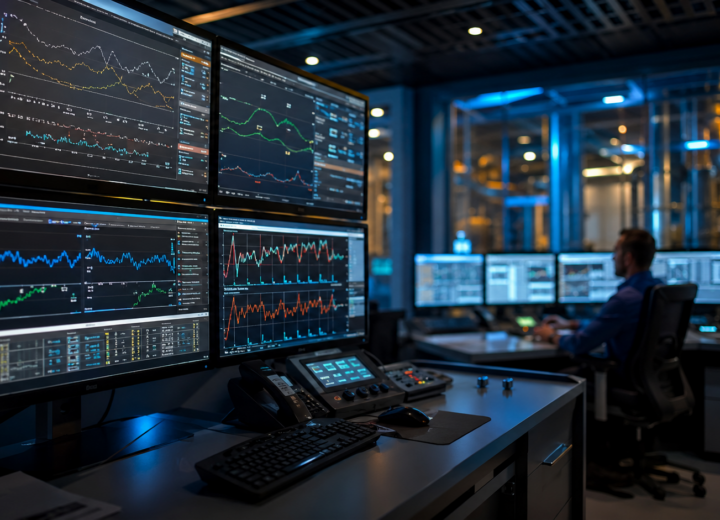
Process control training tends to focus on methods for tuning PID control loops in isolation. Though useful as an academic exercise, practitioners know that real-world applications are rarely so simple. Industrial production units are physically interconnected and, more often than not, the output of one controller influences the Process Variable (PV) of other loops. As a result, retuning a loop that is misbehaving often shifts the symptom to one or more neighboring controller rather than resolving the underlying problem.
Shared process streams, common utilities, and thermally coupled vessels all create paths through which one controller’s action reaches another controller’s Process Variable. A shared steam header is a familiar example: when one consumer draws additional steam, header pressure sags for other loops tied to that header. Interaction is inherent to the process design and cannot be eliminated through control strategy alone.
The Cost of Ignoring Loop Interaction
The cost of unresolved interaction compounds quietly through variability in a facility’s product quality, higher energy consumption, and lost yield. The oscillations from loops that fight each other also drive mechanical wear on control valves, forcing them to move more frequently and across wider ranges than the associated processes actually require.
Research on PID controller performance suggests manufacturers commonly lose 1%-3% of revenue from poor PID control, of which loop interaction is a meaningful contributor. To put that into perspective, a $500 million facility can lose $5-$15 million per year in value. Tools like the Overall Controller Effectiveness Calculator help to translate the impact of poor control by estimating costs for a specific facility.
Fingerprints of Interaction
Loop interaction leaves several recognizable signatures of which four (4) appear consistently across process industries:
- Simultaneous Oscillation across multiple loops. Shared timing across several loops in the same unit almost always points to a physical coupling.
- Loops that perform better in manual than in automatic. When switching to manual reduces the Oscillation, the automatic control is contributing to the instability.
- Loops that briefly improve after tuning, then degrade. When short-term stability gives way to renewed Oscillation, a neighboring loop’s influence is often the actual driver.
- Operator complaints that loops are fighting each other. When operators consistently describe loops as fighting, they are typically correct.
Without appropriate diagnostic tools, these fingerprints can be easily confused with Valve Stiction and sensor noise. As a result, engineers can be misled into addressing symptoms rather than root causes. The most common alternative diagnoses are covered in Are Oscillations Affecting Your Process? and How Stiction Disrupts PID Control.
Diagnosing Interaction at Scale
Some control loop performance monitoring (CLPM) solutions include tools that facilitate data-driven analysis and optimization that scale well beyond the limitations of manual trend-comparison.
Power spectrum analysis is one such tool. It identifies the dominant Oscillation frequencies in each loop. When two or more loops share a dominant frequency, they are almost certainly interacting. That shared frequency can be used to distinguish interaction-driven Oscillation from noise, Stiction, and other sources of variability.
Cross correlation extends the analysis by identifying which loop leads and which lags in the shared Oscillation. That distinction tells the engineer where to intervene, because tuning the lagging loop does not resolve interaction driven by the loop upstream.
Both techniques operate on data a modern historian already captures. PlantESP is a CLPM solution that runs these calculations continuously across hundreds or thousands of loops, ranks the results, and directs engineering attention accordingly. The underlying modeling uses Non-Steady-State Modeling to extract process dynamics from ordinary operational data, without requiring disruptive step tests.
Resolving Interaction Through Decoupling
Once interaction has been diagnosed and the leading loop identified, the fix is not tuning individual loops in isolation. It begins with loop pairing – the exercise of matching each controlled variable to the most appropriate manipulated variable. Two techniques then address the residual interaction directly. Decoupling introduces a compensating signal that cancels the interaction between paired loops. Staggered tuning adjusts the response speeds of the interacting loops so they operate on different timescales and cease to fight each other.
Staggered tuning is often counterintuitive. It requires detuning some loops relative to their apparent single-loop optimum, because a loop responsive enough to reject its own disturbances is also responsive enough to disturb its neighbors. LOOP-PRO Tuner uses the same Non-Steady-State Modeling approach to calculate tuning parameters for each loop in a decoupling strategy.
Case in Point: A Copper Flotation Circuit
The following case study from real customer work in the mining industry illustrates the payoff.
In a four-cell copper froth flotation circuit, froth depth in each cell is regulated by that cell’s outlet, and hydrostatic pressure in the downstream cell influences its inlet flow. The result is a chain of four loops interacting through equipment layout.
With each of the four controllers tuned to a moderate response speed, a Setpoint change on the second cell produced roughly three hours of Oscillation across all four cells. The instability was not a tuning error on any single loop; it was the four loops interacting.
The resolution was staggered tuning. The fourth cell was tuned to the fastest response, the third slower, the second slower still, and the first cell the slowest. Under this approach, the same setpoint change settled in thirty to forty-five minutes rather than three hours, and airflow and inlet flow disturbances recovered in a similarly compressed timeframe. No single loop was tuned aggressively; the whole circuit was tuned to work together.
From Reactive Troubleshooting to Sustained Performance
Interaction is a physical phenomenon that cannot be eliminated by adjusting controllers in isolation. What separates plants that hold tight product specifications and operate near their constraints from those that live with chronic variability is not whether their loops interact. It is whether they recognize interaction, diagnose it accurately, and treat it as a distinct problem with a distinct solution.
The workflow becomes repeatable once a team has run it once. Shared Oscillation frequencies confirm the coupling, cross correlation identifies where to intervene, and staggered tuning decouples the loops so they stop fighting each other. Control Station’s training workshops build that diagnostic and decoupling judgment in engineering teams, so the first case of interaction becomes a repeatable capability applied across the rest of the plant.