
Modeling is a time-tested approach for decoding a process’ dynamic behavior. By understanding how a process responds to change it’s possible to apply an appropriate and timely counter measure. Two common applications of modeling are 1) PID controller tuning, and 2) process simulation.
There are different types of models each with their own strengths and weaknesses. For instance, First Order modeling is the dominant approach applied in the tuning of industrial PID controllers – whether the model is calculated manually or with the help of controller tuning software. While First Order models are easy to compute and offer robust control, they aren’t as precise as their higher order counterparts. Higher order models such as Second Order and Third Order play an important role in process simulation largely due to their improved accuracy. They’re able to capture nuances in a process’ dynamic behavior. However, when it comes to PID tuning those same higher order models are far more challenging to calculate and they provide only marginally better control.
Before jumping to conclusion on which model is best, consider the pros and cons of First Order versus higher order models when viewed in the narrow context of control loop tuning:
First – Fast and Familiar
- The First Order Plus Dead-Time (FOPDT) model and its companion for integrating processes (i.e. FOPDT-Integrating) are by far the dominant models used to tune PID controllers. They are easily calculated and provide performance that’s comparable to higher order models. With so many controllers at a typical plant and ever changing process dynamics, the simplicity and general utility of First Order models make them highly practical. They’re the most familiar to practitioners, and they’re fast to calculate.
- As models transition from First to Second then Third Order, their robustness tends to slip. When used in the context of controller design “robustness” refers to uncertainty and a controller’s ability to function properly using a known set of parameters. Higher order models can be satisfied by a wider range of acceptable parameters. Since there are multiple solutions a higher order model could potentially undermine robustness.
Second – Short and Smooth
- A key benefit of Second and other higher order models is their smoother initial Process Variable response to a change in Controller Output or disturbance. Unlike their First Order counterparts, higher order models avoid the sharp ‘kick’ that typically results from the addition of another time constant in the model and that’s seen in a controller’s eventual, sudden response to change. A smoother transition from one state to another can be of particular benefit when modeling highly sensitive processes.
- With their improved precision higher order models are able to reduce a given process’ estimated Dead-Time. As shared in a previous post, Dead-Time is widely referred to as the “killer of control” so any reduction can only improve a controller’s responsiveness to change. Higher order models pick up on relevant transition points – those additional lags in process behavior that are otherwise overlooked by First Order models. Since higher orders models predict a more accurate, smaller dead-time, the tuning values resulting from higher order models can often times produce faster controller responses.
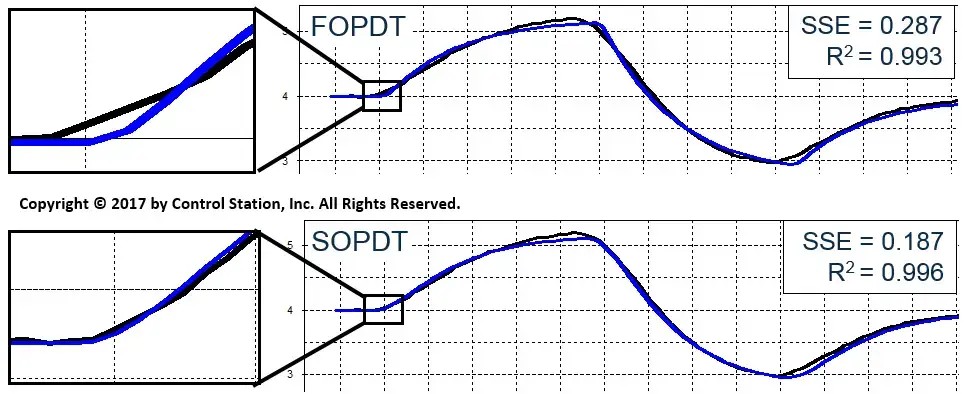
In the realm of process manufacturing, accurate modeling enables practitioners to minimize the negative effects of disturbances and to maintain safe, profitable operations. While higher order models may offer more refined control, it is the simplicity of First Order models that make them the most widely used in industry for tuning of PID control loops.